
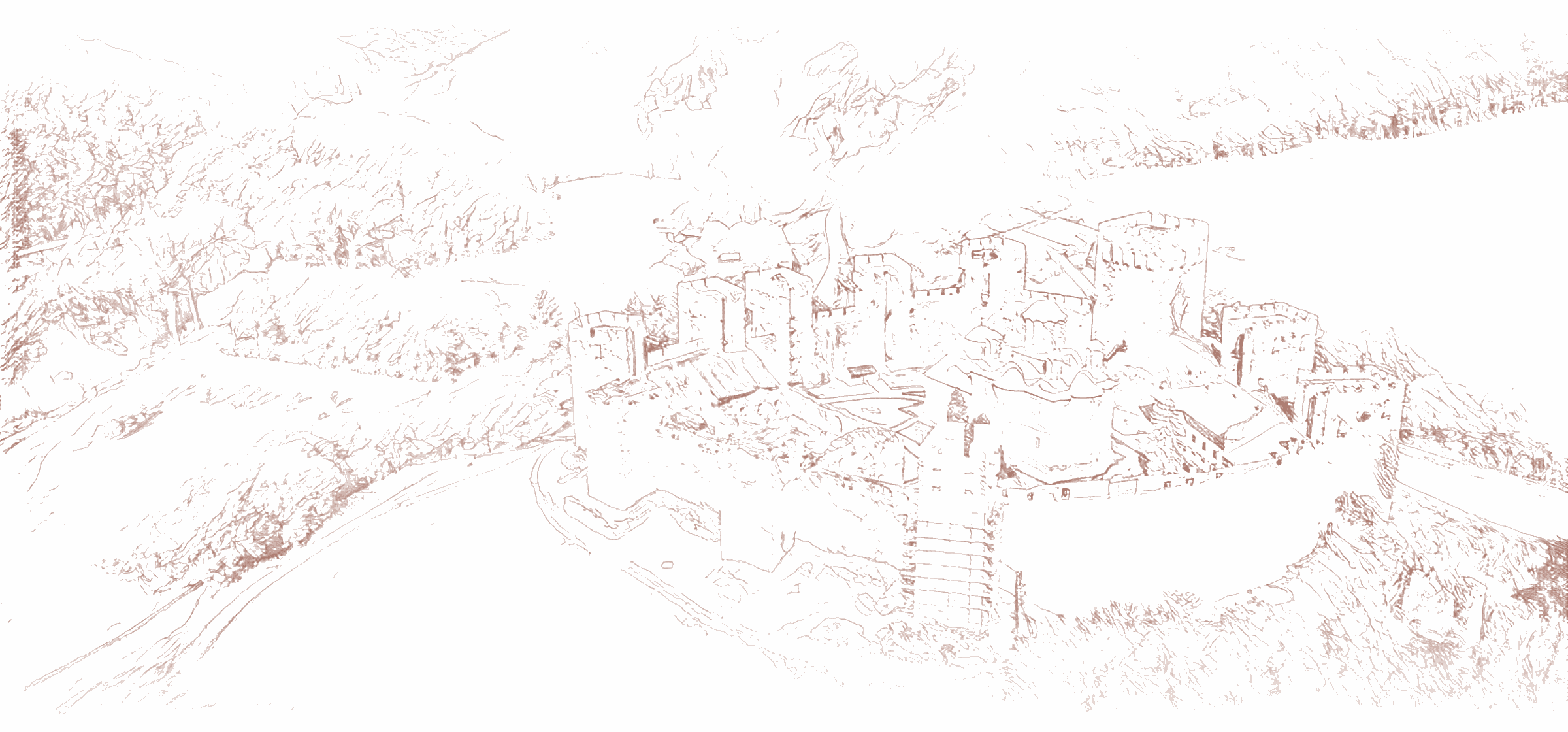


Not even a few decades had passed since the founding of the monastery when Resava suffered for the first time. Since the monastery complex was surrounded by mighty defensive walls with 12 towers, and was additionally protected by a moat 10 meters wide and 6 meters deep, as well as by an additional outer wall (which has not survived), the monastery was used as a fortress. It is recorded that in 1439, after the first fall of Smederevo under Ottoman rule, a Turkish military garrison was stationed in the monastery of Resava;8 the Gabrovo Chronicle, known earlier also as the short Chronicle of the Serbian Rulers, records that in that year the Turkish emperor Murad (Koca II, 1404–1451) took Resava [SSRL 660г; HSV 53]. After the conclusion of the Peace of Szeged in 1444, the Serbian state was restored and the Turkish army withdrew. However, this was a short-lived period of peace. The Chronicle of the Wallachian Monk Mihail Moxa records how very soon, already after 1455, Resava and other towns were conquered by a pasha sent by Sultan Mehmed II the Conqueror (1432–1481) [HMM 41]. According to the Bijelo Polje Chronicle, in 1456 the Resava monastery burned down [SSRL 710]. It is not certain whether the monastery was destroyed by fire as the result of some unfortunate circumstance, or whether that fire was connected with the great Ottoman military campaign of the same year. Shortly before the final fall of the Serbian Despotate, the monastery of Resava was again taken by the Ottomans in 1458: during that year Mahmud Pasha Anđelović (1420–1474) conquered almost the entire territory of the Serbian Despotate, and old manuscripts and chronicles such as the Gabrovac, Dečani, Hilandar, Podgorica, Verković and other chronicles also record Resava among the places Mahmud Pasha seized in this campaign [SSRL 727а–д, 727ж; PL 187 (153); VL 196]. The former inhabitants of the Resava fortress, among whom, owing to the circumstances of war, there were probably both soldiers and laymen, were now, in all likelihood, abandoning it. Thus, according to fragments of the Summary Register of the Sanjak of Vidin from 1466, the revenues of the village of Vrbica near Vinišnica (in the vicinity of present-day Zaječar) were handed over to Nikola, Nikša and Radoslav - who had left Resava by agreement [ZPVS 3 (18)]. According to the data of a Turkish census carried out around 1467, preserved in the Braničevo Defter, that is, the Nominal Register of the Vilayet of Braničevo, in the fortress of the monastery of Resava there was the dizdar Mustafa - the Turkish commander, more than thirty soldiers under his command, as well as the imam Mahmud Fakih, while among the inhabitants the monk Nikon is also mentioned, which some researchers take as evidence that the monastery remained active even after the arrival of the Ottomans. According to this Turkish census, the monk Nikon enjoyed the revenues of two villages and of one monastery that had been "added" to him, as it says, namely of a monastery recorded under the name "Svetoduhna" [BT 250–251]. It is possible that the name of this monastery points to the monastery's Church of the Holy Trinity - the Descent of the Holy Spirit, as some Serbian researchers believe,9 but it is not entirely clear whether the monastery of Resava is meant here or some other monastery.10 In the absence of other data, the concise and summary notes of the census are difficult to interpret. However, it appears that in the decades that followed, soon after the collapse of the Serbian medieval state, the monastery of Resava was left without a monastic community and that monastic life in this monastery died out. The overall circumstances of that time led to such an outcome. The few surviving written testimonies also point, directly and indirectly, to this unfavorable state of affairs and to the decline and extinction of the Resava monastic brotherhood.
- See Stanojević, Bošković and Mirković, Manasija Monastery, 4; Simić and Vukadinović, The Fortification of the Monastery of Resava, 25.
- See, e.g., Bogumil Hrabak, "The Number of Clergy and Monasteries and the Organization of the Church in Serbia from 1470 to 1570" („Бројност свештенства и манастира и организованост Цркве у Србији од 1470. до 1570. године"), in: The Mother of God of Gradac in the History of the Serbian People. Scholarly Conference on the Occasion of 800 Years of the Mother of God of Gradac and the Town of Čačak, November 1992 (Богородица Градачка у историји српског народа), ed. Milovan Vulović (Čačak: National Museum Čačak, 1993), 125–153: 128–129; Ema Miljković and Aleksandar Krstić, "At the Crossroads of Two Epochs: Continuity and Change in the Social Structure of Braničevo in the 15th Century" („На раскршћу две епохе: континуитет и промене друштвене структуре у Браничеву у 15. веку"), Istorijski časopis, vol. LVI (2008): 279–304: 301; Jovanović, Constantine the Philosopher, The Life of Stefan Lazarević, Despot of Serbia, 28; Aleksandar R. Krstić, "The Bells of Resava and the Monks' Betrayal - On a Report from the Nikoljac and Branković Chronicles" („Ресавска звона и монашка издаја - о једној вести из Никољског и Бранковићевог летописа"), in: Days of Serbian Spiritual Transfiguration XXVII. The Middle Ages in Serbian Scholarship, History, Literature and Art XI. Scholarly Conference, Despotovac - Manasija, August 20–21, 2019 (Дани српскога духовног преображења XXVII), ed. Gordana Jovanović, editorial board Stanoje Bojanin, Zlata Bojović, Pavle Dragičević, Jekaterina Jakuškina, Gordana Jovanović, Viktor Savić, Radoslava Stankova, Rada Stijović et al. (Despotovac: Narodna biblioteka "Resavska škola" - Belgrade: Institute for the Serbian Language of SASA, 2021), 181–202: 194, URI: http://rih.iib.ac.rs/id/eprint/1092.
- Cf. the more reserved opinion of Branka Knežević, who raises the question of why the census states that this monastery was "added" to the monk Nikon, if the monastery of Resava is meant: Branka Knežević, "Monasteries in Braničevo According to the Turkish Census of 1467" („Манастири y Браничеву према турском попису из 1467. године"), Saopštenja XX–XXI (1988–1989): 197–209: 206.