

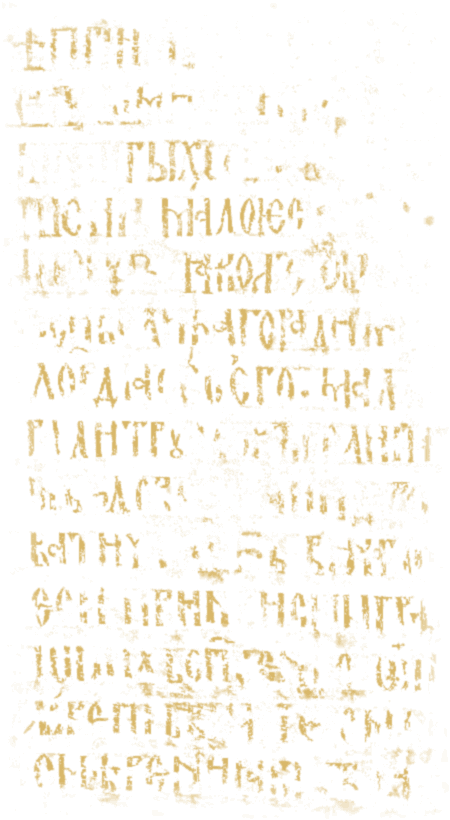
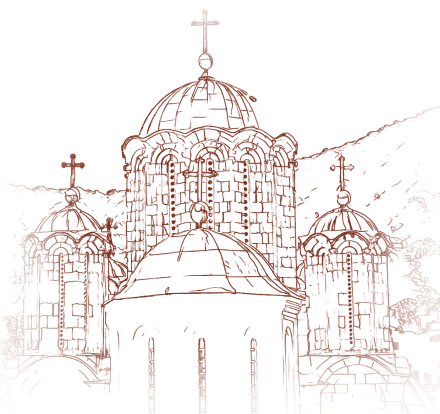
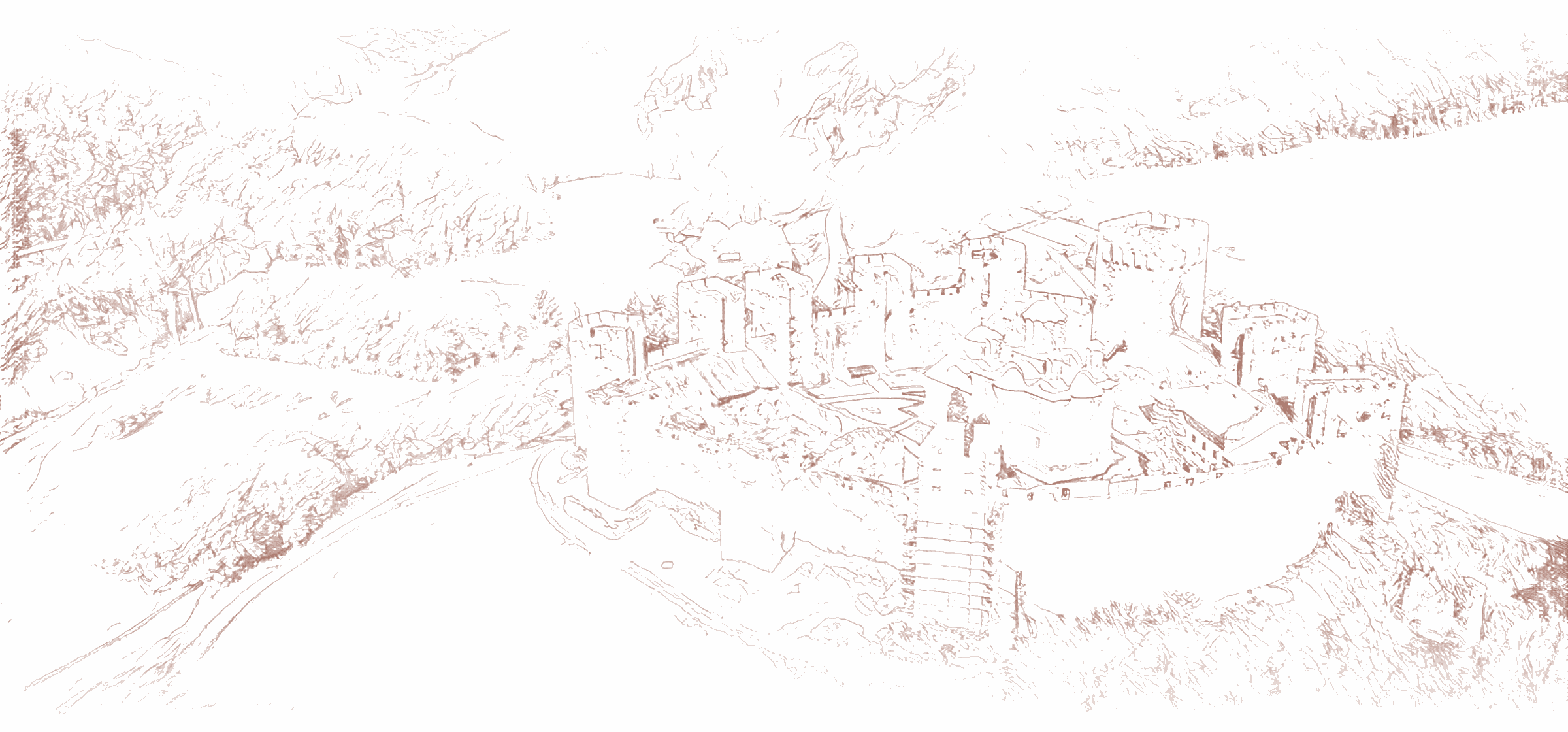


Although the times were times of war and uncertainty, the restoration of Manasija Monastery was set in motion practically immediately after the uprising began. The first Manasija monk whose name we encounter in the historical sources is the abbot Joanikije. According to the notes of E. Simeonović, Joanikije, a native of the Leskovac area, came to Manasija around 1804. Since there were no conditions for living in the monastery, after first building himself a hut "to shelter from the rain and cold," Joanikije, with the help of the local people, immediately set about cleaning and putting in order first the Resava church (which, like the town of Resava, was full of rubbish "more than a fathom high"), and then the fortress. When he had cleared the church of rubbish, the diligent abbot Joanikije re-roofed it with tiles, repairing what was most necessary and renewing the divine services in the monastery, performing "not only the ordinary sacred rites of the Church, but the Holy Liturgy itself."50 People soon began to come to the church. This restoration is also attested in an inscription that had been placed on the façade above the south door of the Manasija church (which, during a later restoration, was plastered over through the carelessness of the masons, as Simeonović notes), stating that the Church of the Descent of the Holy Spirit was restored in 1806, during the rule of the Serbian Supreme Leader (Vožd) Karađorđe Petrović (1762/1768– 1817), under Metropolitan Leontije of Belgrade (Lambros/Lambrović, †1822), through the labor of the abbot Joanikije and the efforts of the oberknez Milija Zdravković (c. 1755–1814) [SSZN 3834]. Simeonović adds that after the expulsion of the Turks from Serbia, through the abbot's efforts, Vožd Karađorđe donated to the monastery a former Turkish watermill on the Resava. In the literature, however, one finds mentions of another instance of damage to the monastery church precisely from this period; it is claimed, namely, that in 1809 a barrel of gunpowder exploded in the narthex of the Resava church.51 If this information is credible, the question arises how gunpowder came to be in the narthex of a church; that would be truly strange, but not impossible, especially in times of war, and particularly if there was no other suitable and dry building in the fortress. Abbot Joanikije built a hut so as to have somewhere to shelter from the rain, as Simeonović mentions; on the other hand, authors from the first half of the 19th century observe that the Manasija Church of the Holy Trinity leaked: this was noted by the Serbian writer Joakim Vujić (1772– 1847), who records that in the church the Turks had ruined the frescoes "and caused great defilement."52 Be that as it may, continuing the restoration, abbot Joanikije went on carrying out repair work on the monastery. The next inscription that speaks of the restoration dates from 1810 and had been placed on the façade of the monastery church, on the right side above the door. This inscription, at the bottom of which "Master Živadin" also signed his name, states that the Manasija Church of the Descent of the Holy Spirit was restored during the time of the right-believing supreme lord Georgije (= Karađorđe), and of the servant of the monastery, the abbot Joanikije, on October 17, 1810 [SSZN 3878].
The words with which this inscription begins are interesting: "The manifestation of this Holy Spirit" (Показателство сегѡ Ст҃агѡ Дх҃а)53 - which point to a pneumatological and eschatological vision on the part of the restorers.
- Cf. I. E. [= Evgenije Simeonović], Description of Manasija Monastery, 13.
- Cf. Jeremija D. Mitrović, "The District of Ćuprija up to 1833" („Ћуприски округ до 1833. године"), in: Temnić Collection. First Book (Темнићски зборник. Прва књига), ed. Dragić M. Joksimović (Belgrade: Štamparija "Privrednik", 1932), 83–143: 106.
- Cf. Ioakim Vuič, The Journey through Serbia of Joakim Vujić, Slaveno-Serbian Writer: Written in Brief in His Own Hand in Kragujevac in Serbia (Іоакіма Вуича Славено-Сербскаго Списателя Путешествіе по Сербіи: во кратцѣ собственномъ рукомъ нѣговомъ списано у Крагоевцу у Сербїи) (Buda: Printed at the Slaveno-Serbian and Other Eastern Languages Press of the Royal University of Pest, 1828), 82. Giving basic information about Manasija Monastery, Joakim Vujić calls the endowment of Saint Despot Stefan an imperial monastery, and writes the following: "This is an imperial monastery, whose founder was Despot Stefan, son of Prince Lazar" (Vuič, The Journey through Serbia of Joakim Vujić, Slaveno-Serbian Writer, 82). Other authors of the past also called Manasija Monastery imperial. For Evgenije Simeonović, Manasija is "one of the most renowned endowments of the Serbian kings and emperors" (S. A. [= Evgenije Simeonović], "Description of Manasija Monastery," 53); even more strikingly, for Josif Veselić Manasija is one of the most renowned endowments "of the Serbian emperors" (Veselić, Description of Monasteries in Serbia. Part 1, 55). In the second half of the 19th century, Manasija Monastery is also called an imperial monastery - a lavra - in official publications (cf. State Calendar of the Kingdom of Serbia for the Leap Year 1896 (Државни календар Краљевине Србије за преступну годину 1896.) (Belgrade: Published and printed by the State Printing House of the Kingdom of Serbia, 1896), 84; State Calendar of the Kingdom of Serbia for the Year 1897 (Државни календар Краљевине Србије за годину 1897). (Belgrade: Published and printed by the State Printing House of the Kingdom of Serbia, 1897), 60; State Calendar of the Kingdom of Serbia for the Year 1898 (Државни календар Краљевине Србије за годину 1898). (Belgrade: Published and printed by the State Printing House of the Kingdom of Serbia, 1898), 137), etc. Namely, in the 19th century, according to the classification of the time, Manasija Monastery was ranked within the Eparchy of Belgrade among the group of the most important monasteries, as an imperial endowment - a lavra, together with the monasteries of Gornjak, Kalenić and Ravanica (cf. Ljubodrag Popović, "The Clergy of the Eparchy of Braničevo - A Contribution to Its History" („Свештенство Браничевске епархије - прилог за историју"), in: Braničevo through the Military and Cultural History of Serbia II: Proceedings of the Scholarly Conference of the Historical Archive of Požarevac Held on October 10, 2006 - In Memory of the Heroes of the Serbian Golgotha of 1916, Issue 4 (Браничево кроз војну и културну историју Србије II), ed. Jasmina Nikolić (Požarevac: Historical Archive of Požarevac, 2007), 79–86: 82; cf. also Gordan Bojković and Nebojša Đokić, Medieval Churches and Monasteries in Braničevo: According to Serbian and Austrian Censuses of the 18th Century (Средњовековне цркве и манастири у Браничеву: по српским и аустријским пописима из XVIII века) (Požarevac: National Museum Požarevac, 2016), 181; cf. also Nebojša D. Đokić, Jelena B. Rogožarski, and Milena M. Baltić, "A Contribution to the History of the Monastery of Nimnik" („Прилог историји манастира Нимник"), Zapisi: Yearbook of the Historical Archive of Požarevac, year XII, no. 12 (2023): 99–112: 107–108, etc.).
- We cite the beginning of the inscription according to the oldest known edition of this text: cf. Vuič, The Journey through Serbia of Joakim Vujić, Slaveno-Serbian Writer, 82.