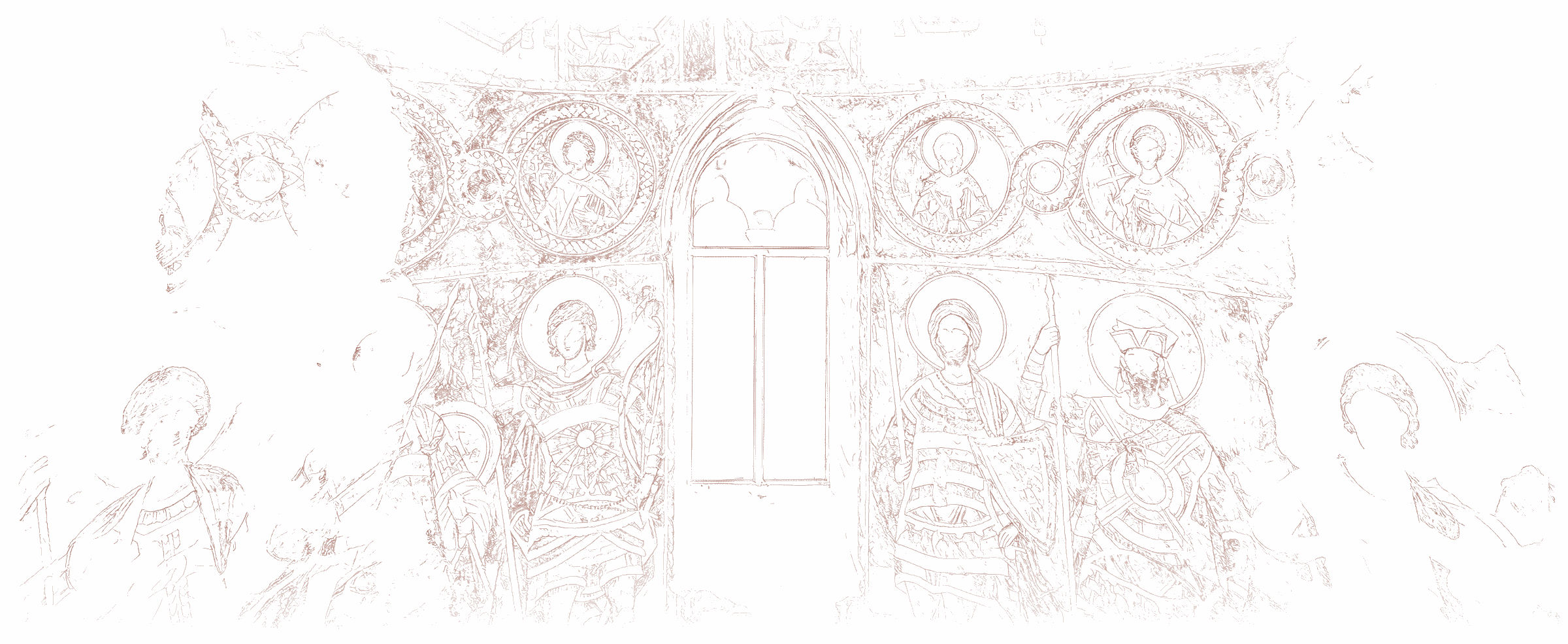

Despot Stefan Lazarević
The Life of the Holy and Right-Believing Stefan the Tall, Despot of Serbia
Page 9 of 44
pious and loving the Church, Stefan from childhood devoted himself to prayer and to attending the holy temples; and this he continued to do also as ruler. For, according to the words of his biographer, he loved "order at the Divine service, keeping extraordinary readings and prayers," and in his land it was "established that they pray more than twice a day," so that "life in his whole land was like a church of God." And in the abundant giving of alms too he modeled himself on his father, and even surpassed him. For he not only fulfilled that old royal saying: "Friends, today we have not reigned, since we have bestowed a gift on no one," but "by his deeds he more than overfilled his days, and never did the one who received rejoice as much as he who gave. For he was then filled with the most perfect joy, when he opened his right hand more widely." But let us return again to the childhood in the life of Stefan. The young Stefan lived peacefully and calmly at his father's court, growing and becoming strong in spirit and body and being educated in divine and human sciences and matters. So it was until his twelfth year. And then suddenly came that terrible Serbian suffering at Kosovo, when his father, the Holy Great Martyr Lazar, perished as a martyr (on June 15, 1389), and with him the flower of the Serbian nobility and soldiers, as is told at length in the Life of the Holy Tsar Lazar under June 15. Of Stefan's grief after Kosovo, as of the grief of his mother, brothers, sisters and all Serbian men and women, need much be said here? For then there came "sorrow upon the earth for the nations and a slaughter of Christians such as there had never been."8 The whole Serbian people and the house of Lazar cried out then only this: "By God's permission we were delivered for our sins into the hands of lawless and hateful enemies and of a tsar unjust and the most wicked on earth. And then there was desolation and great sorrow from the lawless Ishmaelites, such as there has not been nor shall be."9 But even in those most grievous hours of Serbian history the faith and hope of the people's soul in God sang out through the mouth of the poet: "Though the cranes have perished, there remain the chicks, the young cranes; our tribe shall not perish." Such a chick and crane was precisely Saint Stefan. After the Battle of Kosovo, though still a boy, Stefan, with his mother Milica and his brother Vuk, on the counsel also of the most holy Serbian patriarch, translated with the clergy and the people the relics of his Great Martyr father from Priština to the Monastery of Ravanica (in 1391) and there laid them with honor in his endowment. The enslaved Serbian land from then on rested on his feeble shoulders. Since he was then only twelve years old, the affairs of state were conducted by his holy mother - Princess Milica, until the year 1393, when he reached sixteen years of age. Of that period of Milica's rule and of how she struggled to protect the Christian faith and the soul of her people one may see more at length in her Life (under today's date). In her time there occurred that sorrowful event, for her and for Stefan, concerning Stefan's youngest sister Olivera. At the demand of the new Turkish sultan Bayezid, son of Murad, who had perished in the battle with Lazar at Kosovo,10 Olivera had to be given to the sultan's court as wife to the sultan of another faith. This great humiliation Milica and Stefan had to endure "so that
- See Lj. Stojanović, Old Serbian Notes and Inscriptions (Стари српски записи и натписи), Belgrade, 1902, I, 192.
- Written four years after the Battle of Kosovo in a Triodion. Ibid. I, 182.
- Sultan Murad I reigned from 1362 to 1389, and his son Bayezid I from 1389 to 1402.