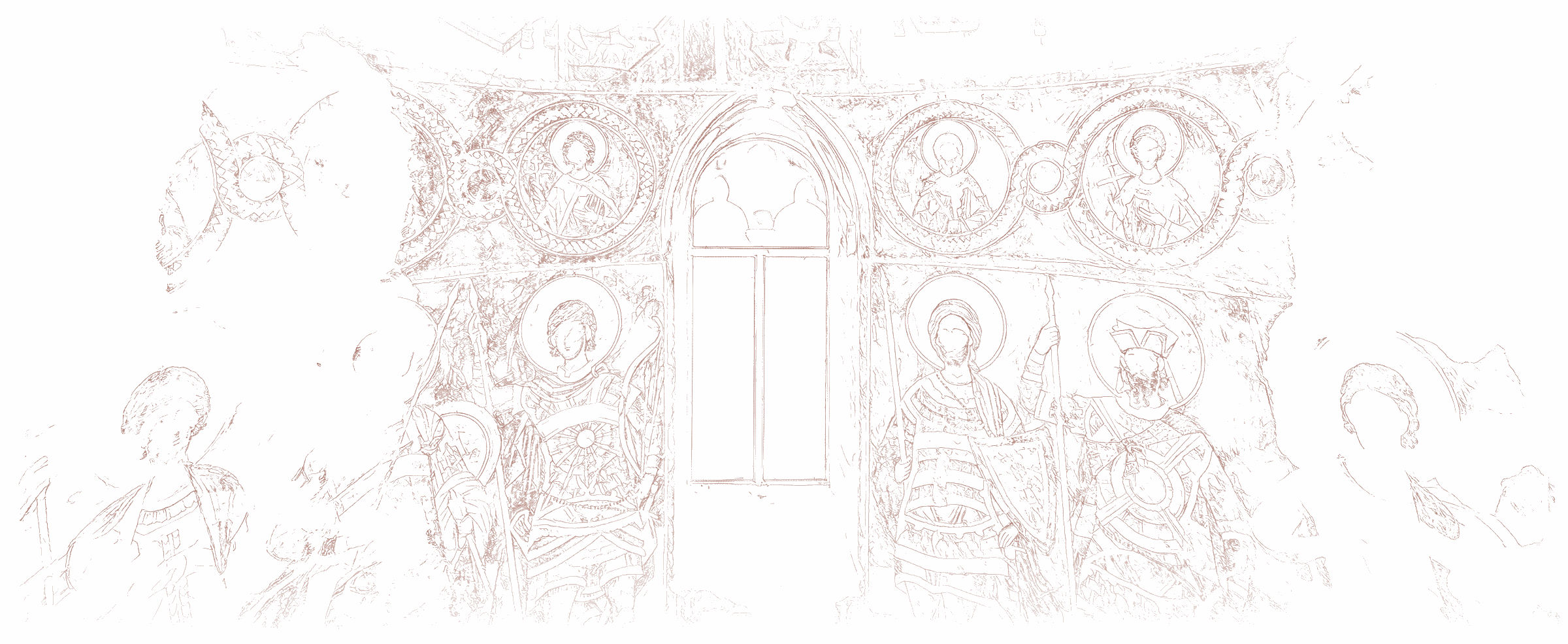

Despot Stefan Lazarević
The Life of the Holy and Right-Believing Stefan the Tall, Despot of Serbia
Page 7 of 44
philosophers, as may be seen from what books he had in his libraries, some of which are preserved to this day (on Mount Athos). For Constantine the Philosopher says of him: "The sovereign lord (Stefan) has a multitude of books in various places and monasteries and in his home."5 Stefan's sincerely pious and strictly Orthodox parents took great care that their son, as the future ruler of Serbia, should be well taught in Orthodoxy, so that afterwards he might steadfastly defend the faith of his fathers among his people against its enemies from the east and from the west. And truly, neither the holy Despot Stefan nor any of his household or his subjects abandoned his Orthodox faith and went over to the Latin faith (Roman Catholicism) or to Mohammedanism. Raised and brought up in Orthodoxy, Stefan remained so throughout his whole life, and as ruler of Serbia he devoted particular attention to preserving the Orthodox faith among his people. Therefore in his Novo Brdo law on mines (issued in 1412) he wrote this about "the Latins and their faith": "Whoever of the Latins and of the townsmen of their faith is found to have converted a person, whether man or woman, from the Christian faith to the Latin faith, let such a one ransom his head from punishment by giving the lord 50 litrae; then let him be driven out of the bounds of the town, and of his patrimony and property let there be no word. And the Latin priest who is found to have baptized a Christian (i.e. converted an Orthodox believer), let his nose be cut off."6 For Stefan's pious upbringing his devout mother Milica took particular care. Well known is her prayer for her children, preserved in the Dečani charter (of 1397), where she thus humbly prays to God for them: "Have mercy upon my sins, strengthen my children in right belief (in the good faith) and in well-being, that in piety they may serve Thee, their God." Alongside Milica, as Stefan's tutor and teacher, was her kinswoman in spirit and in body, the noble nun Jefimija, the former wife of Despot Jovan Uglješa. She lived at the court in Kruševac and, as one "most wise in many matters and discourses," she brought up the daughters of Lazar and Milica in all piety and profitable learning, and when Stefan and his younger brothers Vuk and Dobrovoj (who soon died) were born, she became their tutor and teacher as well. Therefore Stefan would be grateful to her all his life for her "great love and zeal" and would call her his "second mother." Thus the young prince Stefan acquired at his parents' court the best Christian upbringing and worldly "enlightenment," so that later, having become ruler and Despot of Serbia, he was one of the most educated and most enlightened rulers in spiritual and secular learning both in the east and in the west.7 Likewise Stefan was brought up and trained also in good and useful bodily skills and other qualities and virtues which are needful for a military commander and ruler. And these
- Constantine the Philosopher writes this in his work "Treatise on Orthography" (Сказаније о правопису).
- This "Law on Mines of Despot Stefan Lazarević" was published in the original by Nikola Radojčić, SANU, Belgrade 1962 (see law XX, pp. 55–56).
- The only ruler in the Despot's time similar to him in learning was the wise Byzantine Emperor Manuel II Palaiologos (1391–1425). When he and Despot Stefan once met, Constantine the Philosopher recorded: "Like had come to know like."