
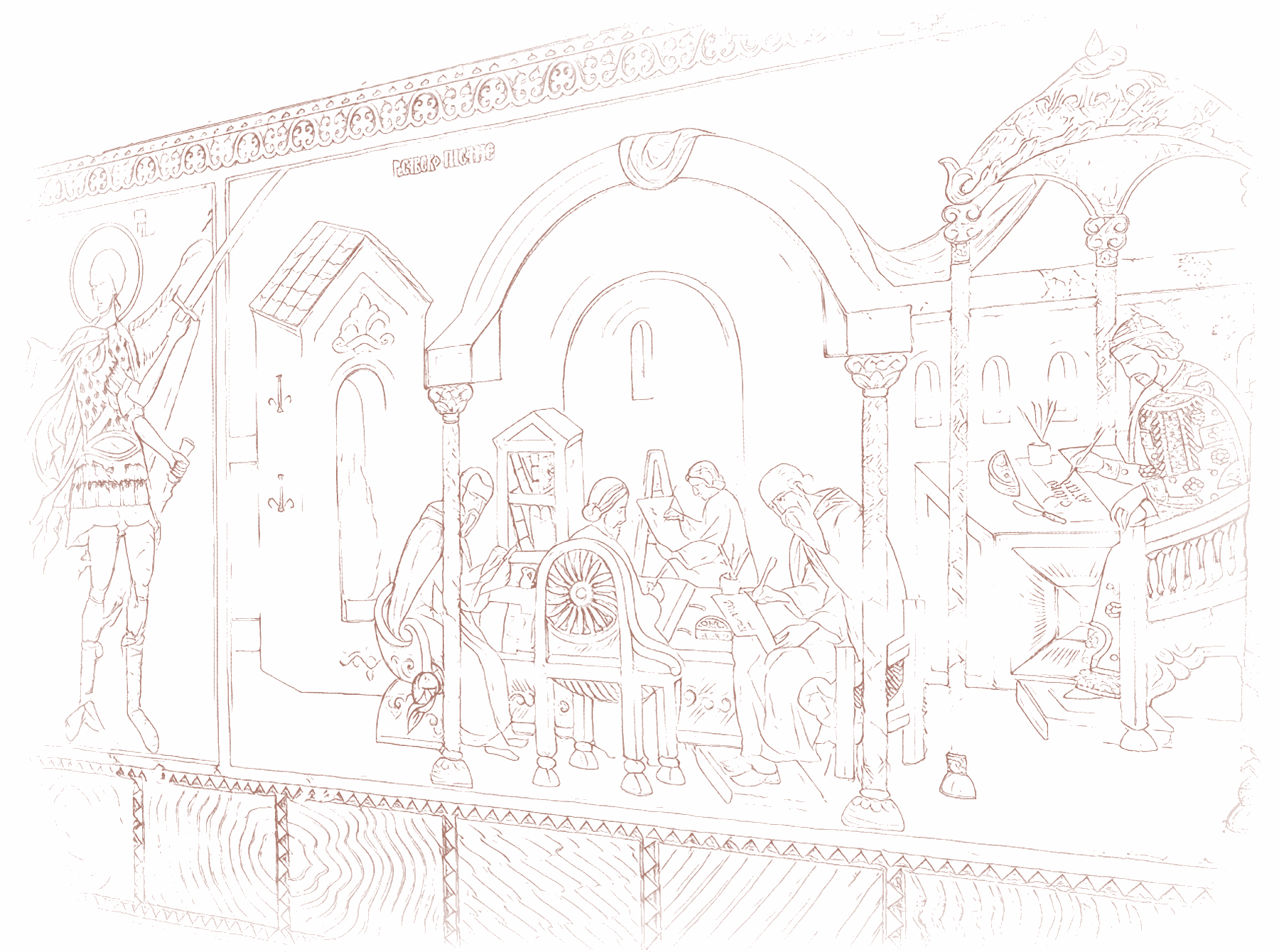

unknown, both because of the fall of the Serbian state and the decay and dispersal of the Serbian cultural heritage, and because of the monastic humility that led them to keep silent about their names and their contribution. The example of the unknown monk of Dalša shows how the influence of the Resava School spread through the Serbian lands. The Monk of Dalša, summoned from Mount Athos, came at the Despot's request to the Serbian Despotate and then remained there, continuing his work. This Serbian scribe and man of letters, of whose origin nothing is known, formerly a monk of Hilandar, was named after his monastery on the little river Dalša, while his name, neither his secular nor his monastic one, has been preserved. The anonymous monk, whose name remains unknown, is remembered as one of the most distinguished copyists of his time, a man whose knowledge and skill attracted the attention of the Serbian ruler himself. His life and work reveal the richness, but also the hardships, of spiritual life in the Serbian lands of the 15th century, marked by almost incessant Turkish incursions and by the approaching shadow of the fall of Serbian statehood. In his work at the Despot's command, the unknown black-robed monk first labored "in the regions of Ljubostinja, in the wilderness near the monastery of the Dormition of the Most Pure One." Later Despot Stefan assigned to him as his dwelling "the church of the Entry of the Most Pure One, near the town of Golubac." The monk searched for a place suitable for founding a monastery, and found it "at the foot of the mountain called Visoka, in name and in truth, on the river called Dalša, at its spring" [SSZN 250], after which he was also given his byname; in this monastery he continued his activity. In the Monastery of the Annunciation near Ždrelo in Gornjak, this diligent monk copied the Radoslav Gospel, in collaboration with the celebrated painter of the Kalenić Monastery, Master Radoslav. That manuscript became a testimony not only to artistic collaboration, but also to the deep spiritual dedication with which the guardians of Slavonic literacy stood against a time of wars and insecurity. Within this Gospel, the monk of unknown name left a short autobiographical note, a small window into his world, but also a window into the life of the Serbian lands of that age. His words depict not only his dedication to his work but also the immeasurable hardships brought by life in a land torn between incessant Turkish threats and the effort to preserve its culture and spirituality. As the Serbian lands became ever more insecure for monastic life, and mortal danger ever more certain, the monk finally decided to withdraw to Mount Athos, the refuge of monasticism and the center of spiritual peace. He took with him one of his works, a short chronicle called the Istorikija, which testifies to Serbian history in the period from 1348 to 1448. This chronicle, though concise, represents a precious record of a turbulent time, noting the events that shaped the destiny of the Serbian lands and the Serbian people. The Serbian translation of the work of John Zonaras known by the title Chronicle, which was probably made as early as the time of the Holy King Milutin, did not satisfy the standard of Despot Stefan Lazarević because of its unreliability. Therefore, at the Despot's command, in 1407 or 1408 the Hilandar monk Gregory undertook to correct the gross errors in the text and to supplement it. Gregory compared sources that included the Old and New Testaments, as well as the works of well-known classical and late Byzantine authors. Thus arose a revised version of the Serbian translation of the Chronicle of Zonaras, which in
Manasija Monastery · Imperial Lavra of the Holy Trinity

Manasija
loading the page