

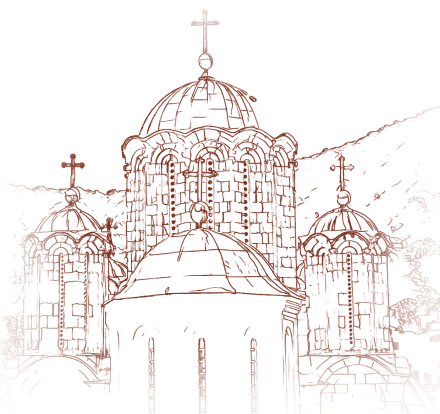
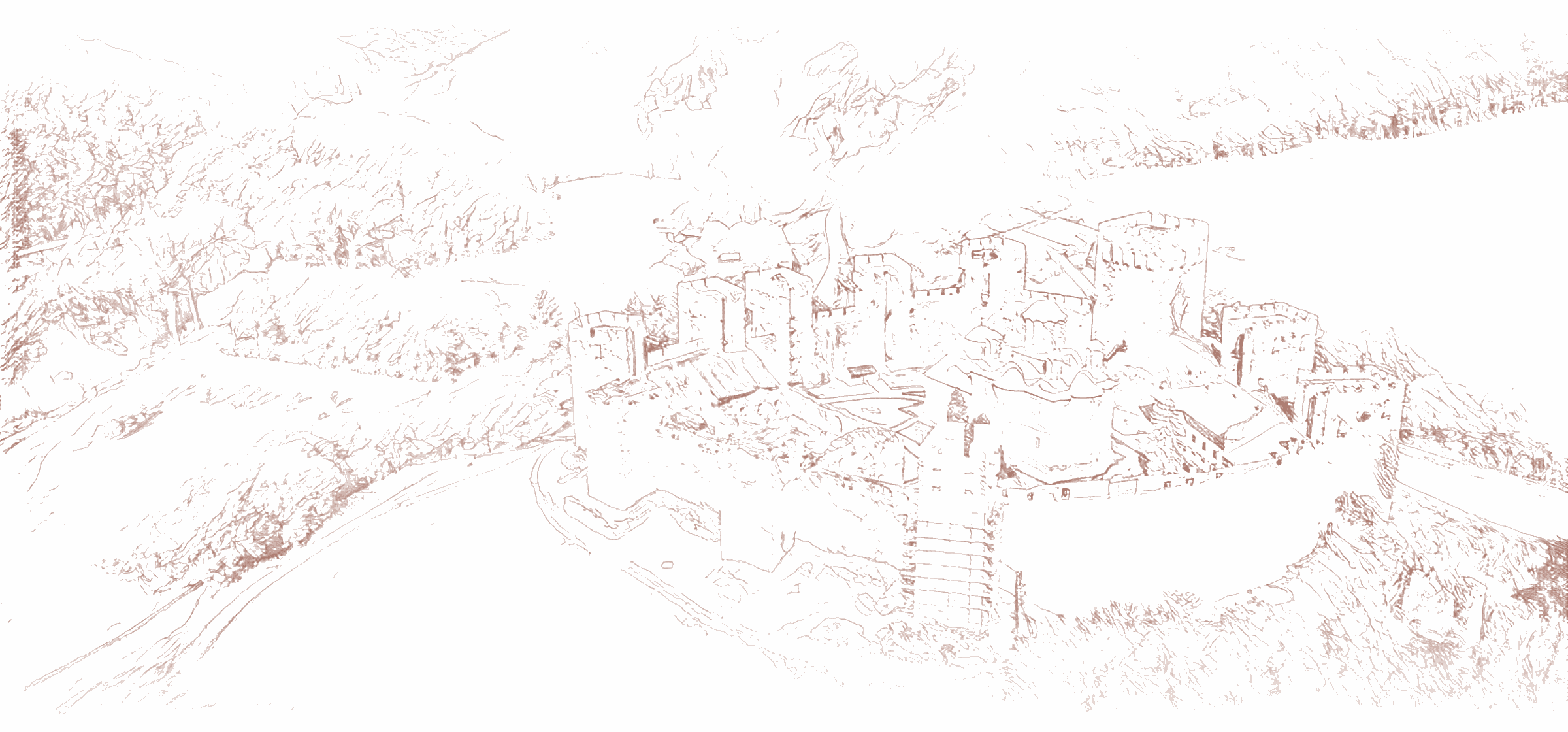


It is worth mentioning that, although Manasija Monastery was not in splendid condition in this period, and on the one hand found itself in serious crisis, on the other hand the Manasija church remained a representative example of church architecture. In the 18th century the Kovilj church was built on the model of that of Manasija. In the 19th century, in 1850, the Manasija Church of the Holy Trinity was chosen as the architectural model for building the Church of Saint George in Smederevo; following the model of the katholikon of Manasija Monastery, the painter and builder Andreja Damjanović of Veles (1813–1878) made the drawings and, in part, built according to them the Smederevo church, which was erected in 1851–1854.108 In the second half of the 19th century Manasija Monastery was visited by Felix Kanitz (Felix Philipp Emanuel Kanitz, 1829– 1904), the famous German travel writer and archaeologist, who recorded the appearance of Manasija Monastery and the Manasija church in his drawings of 1862 and 1876,109 and noted the following about the Resava monastery, which is reached by a road leading across a bridge over the Resava: "Over that water a new stone bridge has been built with an arch - once you cross it and go on a little further, there at once gleams before you the most remarkable building in Serbia, and perhaps the most remarkable in Europe as well, Manasija Monastery, the endowment of Stevan the Tall."110 These words of his were later repeated by Sava Bjelanović (1850–1897)111 and Radoslav Grujić (1878–1955).112 The German travel writer Gustav Rasch (1825–1878) visited Manasija around 1870, and although the Resava fortress was in a ruinous state, he was enraptured and expressed himself as follows: "What an impressive sight! No ruin in Germany, which is so rich in castle ruins, has left so powerful an impression on me as the sight of Manasija."113 In the same spirit, the Serbian geographer and diplomat Vladimir Karić (1848–1894) speaks of the fortress and also of the jewel of Manasija, the Church of the Holy Trinity, saying that by its manner of construction this church is our most beautiful old building.114 Drawings and sketches of Manasija Monastery in this period were also made by the painter and architect Vladislav Titelbah (Franc Ladislav Tittelbach, 1847– 1925)115 and by General Jovan Mišković (1844–1908).116 As someone who visited Manasija Monastery several times, Kanitz had the opportunity to become acquainted with Archimandrite Evgenije and with his successor, the abbot and later archimandrite Kiril Vukelić (born around 1827),117 who held the position of superior of the monastery from 1861 until his passing into the Kingdom of God in 1896.
- Cf. Dejan Medaković, Researchers of Serbian Antiquities (Истраживачи српских старина) (Belgrade: Prosveta, 1985), 12–13.
- Cf. Feliks Kanic, Byzantine Monuments in Serbia (Византијски споменици по Србији), translated by Aleksandar Sandić (Vienna: printed at the Imperial-Royal Court and State Printing House, 1862), Pl. II, V; Felix Kanitz, Das königreich Serbien und das Serbenvolk: Von der Römerzeit bis zur Gegenwart. Erster Band. Land und Bevölkerung, Monographien der Balkanstaaten, I. Serbien (Leipzig: Verlag von Bernh Meyer, 1904), 265; Simić and Vukadinović, The Fortification of the Monastery of Resava, 34, fig. 7; Igor Borozan, "Illustration in the Service of Reviving the Middle Ages. Topographical and Historical Depictions from Felix Kanitz's Byzantine Monuments in Serbia" („Илустрација у служби обнове средњовековља. Топографско-историјски прикази из Византијских споменика по Србији Феликса Каница"), Zograf: A Journal for Medieval Art, no. 43 (2019): 197–214: 205, https://doi.org/10.2298/ZOG1943197B.
- Kanic, Byzantine Monuments in Serbia, 22. Kanitz devoted great attention to Manasija Monastery - cf., e.g., Kanitz, Das königreich Serbien und das Serbenvolk: Von der Römerzeit bis zur Gegenwart. Erster Band. Land und Bevölkerung, 265–273.
- Cf. Sava Bjelanović, Through the Slavic Lands: Memories and Notes from a Journey (Кроз славенске земље: успомене и биљешке с пута) (Zadar: Štamparija Špire Artale, 1897), 252–253.
- Cf. Rad[oslav]. M. Grujić, The Orthodox Serbian Church (Православна Српска Црква) (Belgrade: Izdavačka knjižarnica Gece Kona, 1921), 33–34.
- Cf. Gustav Rasch, Der Leuchtthurm des Ostens: Serbien und die Serben (Prag: Dr. F. Skrejšovský, 1873), 307– 316: 308.
- Cf. Vladimir Karić, Serbia: A Description of the Land, the People and the State (Србија: опис земље, народа и државе), written by Prof. V[ladimir]. Karić, illustrated by Prof. V[ladislav]. Titelbah (Belgrade: Royal Serbian State Printing House, 1887), 816– 817.
- For reproductions of Titelbah's drawings of Manasija Monastery from 1882 and 1887, see Simić and Vukadinović, The Fortification of the Monastery of Resava, 34–35, fig. 8 and fig. 9.
- Cf. Jovan Mišković, "Some Old Towns and Their Surroundings in the Kingdom of Serbia [II. Resava (Manasija). III. Gamzigrad. IV. Kostolac of the Timok (Kostol)]" („Неки стари градови и њихове околине у Краљевини Србији"), Starinar of the Serbian Archaeological Society, year 4, no. 3 (1887): 65–73, Pl. VI; for a reproduction of Mišković's plan of the town of Manasija from 1887, see Simić and Vukadinović, The Fortification of the Monastery of Resava, 31, fig. 5.
- Kiril Vukelić was born in Ruma; as a hieromonk he was appointed abbot of Manasija Monastery in 1861, and in 1870 he was raised to archimandrite. It is recorded of him that he was diligent and thrifty, a great patriot and a good steward. He significantly improved the monastery estate. He was delegated as the representative of the Resava district to the Constituent Assembly in Kragujevac in 1869 (but at its first session the national assembly refused to accept him as the representative of the people of Resava, since he was in monastic orders - cf. Minutes of the Great National Assembly Held on June 10, 1869, in Kragujevac (Протоколи Велике народне скупштине држане 10. јунија 1869. године у Крагујевцу) (Belgrade: State Printing House, 1870), 12). As a member of the Serbian Agricultural Society he actively collaborated and exchanged experience with its members; in 1873 he gave this society "six oka of seed of various vegetables" that he had produced on the monastery estate - which was enough for the whole Society. Although he had opportunities to advance in his ecclesiastical career, he did not wish to leave the monastery even when there was a prospect of being promoted to a higher and better position. For a short biography of Kiril Vukelić, cf. M[irko]. [M.] Tišma, "Vukelić, Kiril, Archimandrite, Superior (? - Manasija Monastery, 11 VIII 1896)" („Вукелић, Кирил, архимандрит, настојатељ (? - ман. Манасија, 11. VIII 1896)"), in: Serbian Biographical Dictionary 2. V–G (Српски биографски речник 2. В–Г), editor-in-chief Čedomir Popov, eds. Zlata Bojović, Marija Kleut, Božidar Kovaček, Vojislav Marić, Petar Mikić, Milivoj Nenin, Sreten Petković, Danica Petrović, Savo Skoko, Miroslav Timotijević, Leposava Šelmić and Marica Šuput, editorial staff Milica Bujas and Tatjana Pivnički-Drinić (Novi Sad: Matica srpska, 2006), 422; cf. also Stojadin Tomić, Monasteries and Churches in Upper Resava (Манастири и цркве у Горњој Ресави) (Despotovac: Narodna biblioteka "Resavska škola" - Belgrade: Cultural and Educational Community of Serbia, 2023), 96–100.