

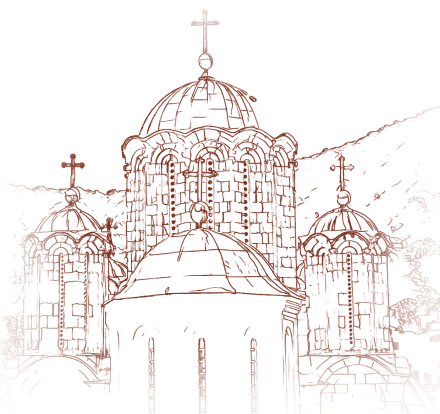


After some twenty years of relative peace, by the end of 1738 the Turks had again established their rule over most of northern Serbia, except for the immediate surroundings of Šabac and Belgrade. When strong Ottoman forces defeated the Austrian army at the Battle of Grocka in July 1739 and then took Belgrade, the outcome of the war was decided;37 the two powers concluded the Peace of Belgrade in September of the same year, and the Austrian army withdrew from Serbia, while the Turks again occupied the lands up to the Danube and the Sava. These military and political changes had grave consequences for the Serbian clergy and monks who remained in the areas under Turkish rule, as well as for the Christian population as a whole, as is attested by the great migration of 1740, in which Serbs in great numbers reached as far as Russia and settled in the eastern parts of present-day Ukraine. The monks migrated as well. In 1739 the monks who had fled from Manasija were settled in the monastery of Bođani,38 in the Eparchy of Bačka - arriving at, or perhaps rejoining, their former abbot Joasaf, if he had moved to Bođani a few years earlier. Together with the monks from Manasija, icons, church furnishings and various objects also arrived in Bođani, as well as books, among which were some of those that the exarch Maksim Radković had listed in the Resava monastery in 1733; these were entered in the monastery inventory as belonging to Resava. But it is possible that not everything was recorded: in the monastery of Bođani there are still icons originating from Manasija that were not entered in the inventory on this occasion.39 The Manasija monks took with them their treasure, which also included 35 books, among others the large Russian Psalter that Metropolitan Mojsije Petrović had donated to Manasija Monastery somewhat earlier.40 Perhaps in connection with this exile of the Resava community, the "Manasijci," that is, the monks of Manasija Monastery, are mentioned in a commemoration book (pomenik) from the monastery of Vrdnik, which, however, cannot be precisely dated [SP 138]. In the description of the monastery of Bođani dated January 25, 1756, the list of the brethren includes among the members of the monastic community former Resava monks as well: the abbot Joasaf Stefanović from Senta (most probably the former Resava abbot) and two other hieromonks - Janićije Tomašević from Kragujevac and Jefrem from Szeged, all three of them tonsured in the monastery of Resava.41 The influence of Resava spread to other monasteries of the Eparchy of Bačka. Through the efforts of the superior of the monastery of Kovilj, Archimandrite Agapije Popović, on September 17, 1741, in Petrovaradinski Šanac, before Bishop Visarion Pavlović of Bačka (1670–1756), the brotherhood of the Kovilj monastery concluded a contract with master builders for the construction of a new large church of dressed stone, which was to be built on the model of the church of Manasija Monastery, both inside and outside.42 It is interesting that one of the signatories of the contract was the abbot of Bođani, Joasaf [KONT 88]; as the former superior of Manasija Monastery, who among other things had directed the restoration of the monastery during the first half of the 4th decade of the 18th century, he could certainly have been of great help both to those who commissioned this particular work and to those who carried it out.
- Cf. Radmila Tričković, "Ćuprija and the Middle Morava Valley up to the First Serbian Uprising" („Ћуприја и средње Поморавље до Првог српског устанка"), in: The Battle of Ivankovac 1805 (Бој на Иванковцу 1805), ed. Vasa Čubrilović, Serbian Academy of Sciences and Arts. Special Editions, vol. DXXII. Department of Historical Sciences, vol. 6 (Belgrade - Ćuprija: Serbian Academy of Sciences and Arts - Self-Managed Community of Interest for Culture of the Municipal Assembly of Ćuprija, 1979), 85–169: 143–144; see also Radmila Tričković, "Belgrade under Turkish Rule, 1521–1804" („Београд под турском влашћу 1521–1804. године"), in: The History of Belgrade (Историја Београда), ed. Nikola Tasić et al., Serbian Academy of Sciences and Arts, Institute for Balkan Studies. Special Editions, vol. 62 (Belgrade: Institute for Balkan Studies of SASA - IK "Draganić", 1995), 91–141: 126.
- Cf. Petar Momirović, "A Contribution to the History of the Monastery of Kovilj" („Прилог историји манастира Ковиља"), Saopštenja XXV (1993): 209–218: 214.
- Cf. Šelmić, "Icons of the Monastery of Bođani from the First Half of the 18th Century," 288–291; Ljiljana N. Stošić, "At the Crossroads of East and West: Žefarović in the Monastery of Bođani (1737)" („На размеђу Истока и Запада: Жефаровић у манастиру Бођани (1737)"), Živopis: A Journal for the Cultivation of Church Art, year 12, no. 12, (2023): 55–64: 60, https://doi.org/10.18485/zivopis.2023.12.12.3; probably not all the books that arrived in Bođani in this migration were recorded either - cf. Žarko D. Vojnović, "Monastery Libraries in the Territory of the Metropolitanate of Karlovci in the 18th Century" („Манастирске библиотеке на подручју Карловачке митрополије у 18. веку") (doctoral dissertation. University of Belgrade, Faculty of Philology, 2018), 223.
- Cf. Petar Momirović, The Monastery of Bođani (Манастир Бођани) (Bođani: Serbian Orthodox Monastery of Bođani, 1980), 24– 25; Vojnović, "Monastery Libraries in the Territory of the Metropolitanate of Karlovci in the 18th Century," 219, 222–223.
- Cf. Lazar Mirković, "A Note on Bođani" („Белешка о Бођанима"), Glasnik of the Historical Society in Novi Sad, vol. III, no. I (1930): 107.
- For more details on this contract and building undertaking, see Momirović, "A Contribution to the History of the Monastery of Kovilj," 213–215; also Miron Đorđević, The History of the Saint Sava Monastery of Kovilj, Church of the Holy Archangels Michael and Gabriel, in the God-Protected Eparchy of Bačka: With an Introduction on the Monastic Order in General and among the Serbs. Written by Miron Đorđević (Историја Светосавског манастира Ковиља Храма Св. Аранђела Михајила и Гаврила у богоспасајемој епархији Бачкој) (Novi Sad: Published by the Monastery of Kovilj, 1891), 85–90.