

Despot Stefan Lazarević
The Homily on Love by Despot Stefan
Page 2 of 12

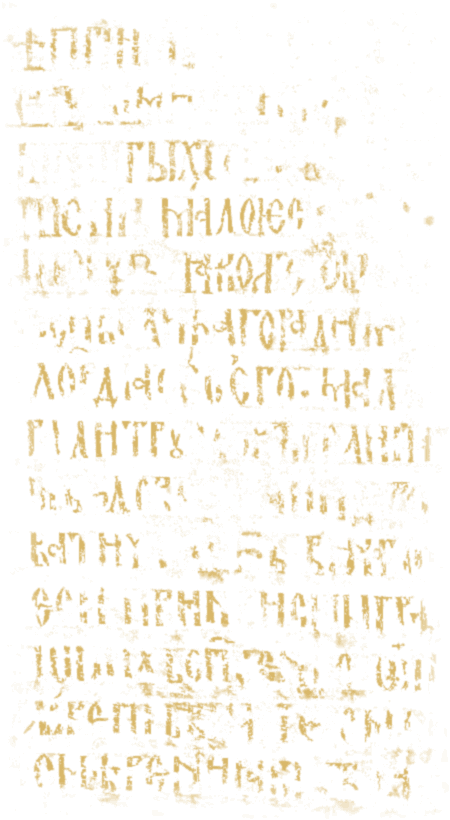
of Belgrade on April 6, 1941. Although there are 19th-century editions of this manuscript (it was first published by Đura Daničić in 1859, then by Stojan Novaković in 1877) and a photograph of its first page (published by D. Kostić), the loss of this manuscript, which Daničić considered to be the Despot's autograph, is irreparable damage to Serbian culture. Had it been preserved, modern methods of analysis would have made it possible to establish the time of its composition more precisely. A copy of the Homily on Love from the middle of the 15th century has, however, been preserved; it is in the Museum of the Serbian Orthodox Church in Belgrade (Museum of the Serbian Orthodox Church, no. 159), and was brought there from the Krušedol Monastery on Fruška Gora.
Jovan Deretić (1934–2002), a historian of Serbian literature, considers A Word on Love to be one of the most beautiful poetic achievements of Serbian medieval literature. This work, filled with noble feelings and deep lyricism, remains a testimony not only to a great ruler, but also to a man who understood and valued the power of love, of concord and of art.
This literary pearl is built in ten sections, with the initial letters of each part forming the name of the text itself, a distinctive stylistic feature that testifies to the poetic skill and erudition of the author. The particular charm of this work lies in its subtlety - instead of direct words, feelings are expressed through symbols and hints. This manner of writing, on which many literary scholars have left their observations, gives the text an air of refinement and artistic subtlety.
Although the political situation in the Serbian Despotate at the beginning of the 15th century was very complex, in the Homily on Love Despot Stefan speaks not as a ruler, but as a man and a poet. His message is not only a call to peace, but also a hymn to love and beauty. He sees beauty in God's providence and in God's creation, in created nature, which points to the uncreated; he further finds beauty in moral values and in man. His philosophy of beauty rests on the unity of physical, moral and spiritual beauty. Although not large in scope, this work is full of biblical motifs, allusions and quotations.
Although the poet remains reticent in expressing his emotions, when he describes nature he presents it in a wealth of detail, vividly and plastically, with scenes that seem to carry within them a spark of the future artistic renewal that would flourish centuries later. The poet does not hide his fascination with the beauty of the world, creating lavish images that reflect his inner sensibility. This work, regardless of the historical circumstances in which it was created, is far more than an ordinary political or family message. It is one of the most beautiful expressions of love, whether brotherly, spiritual or a universal love of life, of nature and of man - all of which culminate in the love of God. In it are reflected the noble aspirations of a ruler who, despite military challenges and political circumstances, finds the strength to write with his own hand words that will resound through the centuries.
As a poet, Stefan Lazarević showed exceptional skill in shaping verse. His inspiration is powerful, which results in rhythmically varied stanzas. Such freedom in shaping verse points to a deep understanding of poetic principles. In particular