
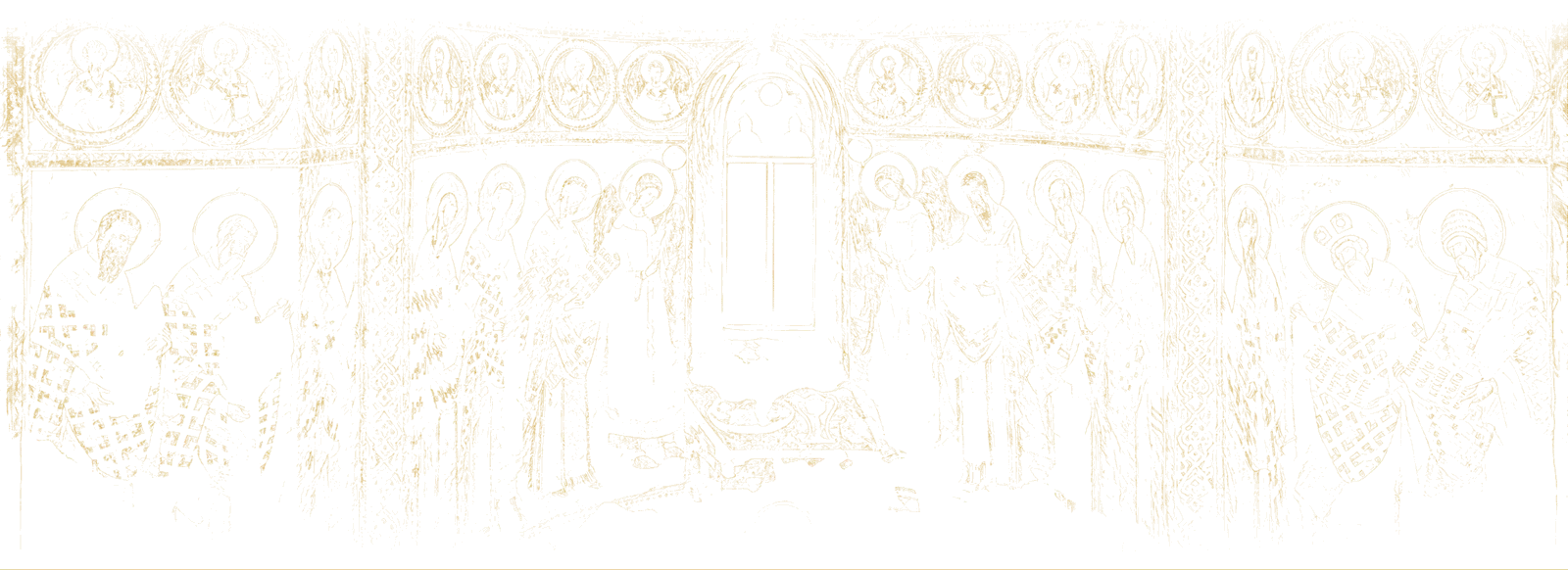
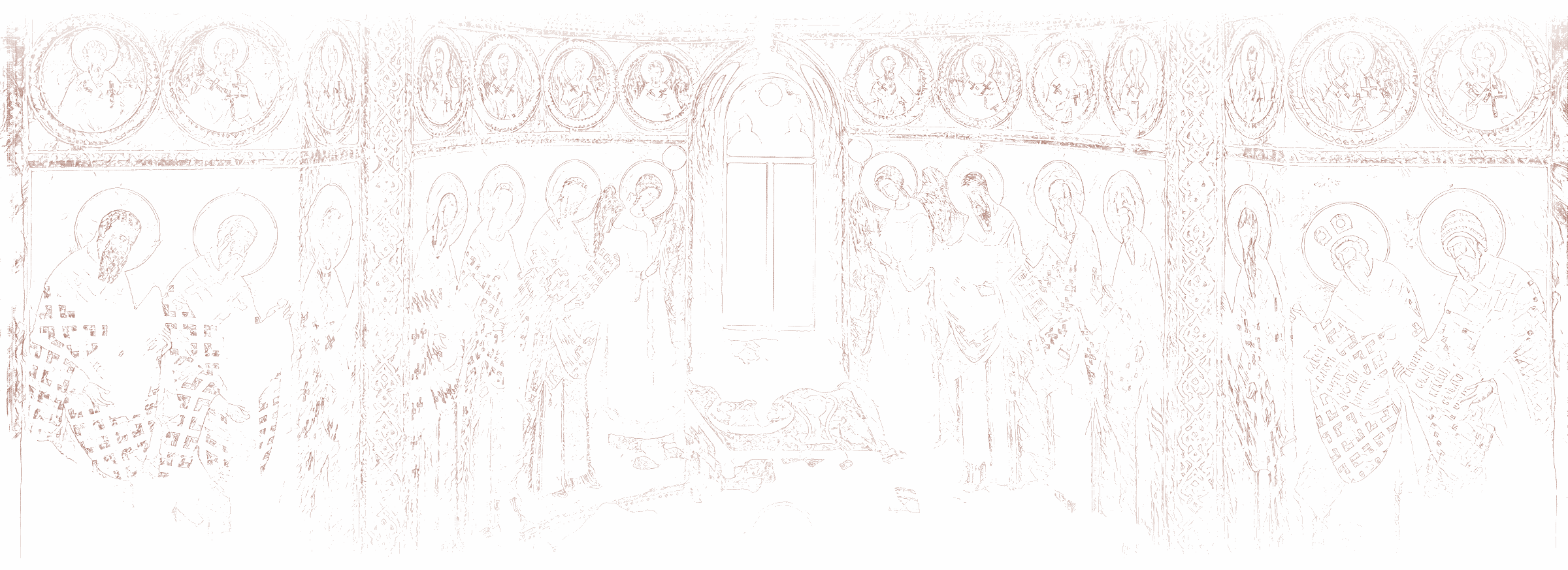
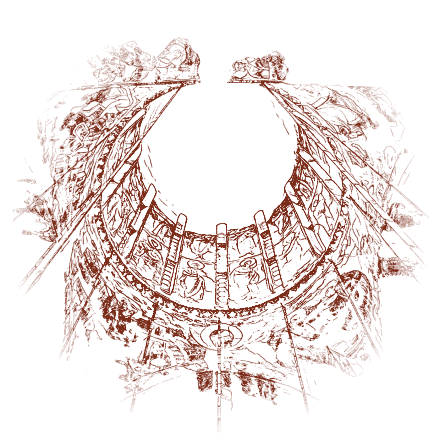

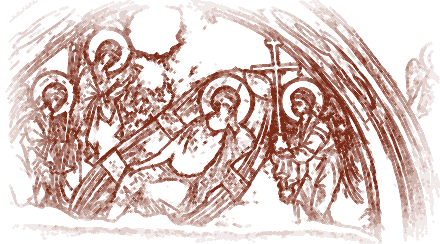
In the calotte of the main dome a monumental bust of Christ Pantokrator was painted. Around the Pantokrator, in a spherical ring, the Heavenly Liturgy celebrated by angels was depicted, as a parallel to the liturgical rite on earth. Of this composition only fragments survive today. The twelve-sided drum of the central dome is painted with figures of Old Testament prophets and high priests, who hold in their hands scrolls with scriptural quotations of their prophecies. Altogether twenty-four figures are placed in two rows between twelve narrow windows. In the figures of these Old Testament prophets and leaders of Israel, majestic and full of spiritual power, are represented those biblical personages who, glorifying God, foretold the coming of the Savior, Christ. In the upper zone are painted the figures of the Holy Prophet Elijah, then of his disciple the Holy Prophet Elisha, the Holy Prophet Ezekiel, the Holy Prophet Habakkuk, the Holy Prophet Jeremiah, the Holy Prophet Zechariah, the Holy Prophet Jonah, the Holy Prophet Joel, the Holy Prophet Malachi, the Holy Prophet Daniel, the Holy Prophet Isaiah, and the Holy Prophet John the Forerunner - the Baptist of the Lord. In the lower zone are painted the figures of the Holy Prophet Zephaniah, the Holy Prophet Obadiah, the Holy Prophet Haggai, the Holy Prophet Nahum, the Holy Prophet Gideon (judge of Israel), the Holy Prophet Hosea, the Holy Prophet Amos, the Holy Prophet Samuel, the Holy Prophet Zechariah (the high priest and father of Saint John the Forerunner), the Holy Prophet Aaron, the Holy Prophet Moses and the Holy Prophet Micah. While the Old Testament prophets could sense the coming of Christ in visions, the evangelists were witnesses of His incarnation, His life and works on earth, and finally of Christ's resurrection and ascension: they too are painted in the church of Manasija. Matthew, Mark, Luke and John, the authors of the four Gospels that constitute the foundation of the Christian faith, are depicted, according to the customary arrangement of medieval church art, on the pendentives beneath the central dome. On the southeastern pendentive, the Holy Evangelist John the Theologian is painted in a cave on the island of Patmos, receiving divine inspiration through a ray of light while dictating the words to his disciple Saint Prochorus. The Holy Evangelist Mark is represented on the southwestern pendentive, painted reading a written text. On the northeastern pendentive the Holy Evangelist Luke is shown in a scriptorium with a pen in his hand, ready to copy a text, and on the northwestern pendentive is painted the Holy Evangelist Matthew, composing his writing in a sumptuous multistory building with terraces and a staircase. Alongside the evangelists are also painted their traditional representations - symbols based on the descriptions in the vision of the Holy Prophet Ezekiel (Ezek. 1:10) and in the Revelation of John (Rev. 4:7), which point to the characteristics of their Gospel accounts: the image of an eagle beside Saint John the Theologian (for with his theological approach and inspired writing he rises above the others as an eagle rises above the earth), the image of a lion beside Saint Mark (for he begins his Gospel with the account of John the Baptist, who is like a lion roaring in the wilderness), the image of a calf beside Saint Luke (who begins his account with the story of the Jewish high priest Zechariah and
Manasija Monastery · Imperial Lavra of the Holy Trinity
Manasija
loading the page